Random Word Generator: Common Words for Games, Class and Writing
Pick a word class, a letter and a length, and the random word generator below deals common English words fairly, labels every part of speech each one really has, and keeps a no-repeat deck for game night. Nothing you draw leaves your browser.
Pick a word class, set a letter or length if you need one, and press Generate. Tap a word to copy it; the star keeps it in your list.
5 seconds to look at the word, then 60 seconds to draw or act it out. No letters, numbers or talking.
Your word list 0
Your list stays in this browser only.
Words on screen in thirty seconds
- Pick a word class. All words, nouns, verbs, adjectives or adverbs; each button shows how many words it holds. For a drawing game I start with nouns; for acting games, verbs.
- Narrow it if you need to. Open "Letters, length and more" for a first letter, a last letter, a minimum and maximum length (2 to 14 letters) or one exact length from 3 to 8. Every letter shows its word count in brackets, and letters with no matches are switched off instead of failing silently. A live counter above a small bar tells you how many words still match before you draw.
- Choose how many. Anything from 1 to 200 words. Ask for more than the filters allow and you get a plain notice, "Only 2 words match these filters, so you get all of them", rather than a quietly shorter list.
- Keep the good ones. Every card has a copy button and a separate star that saves the word to your list. The saved list stays in your browser between visits and copies or downloads as lines, commas, spaces or CSV with each word's classes.
Running a game? The mode switch has three settings. List is the plain draw. Deck, no repeats deals words without replacement and counts what is left. Game card shows one big word, hides it after a five-second peek or a tap, and runs a one-minute ring timer for the round.
What the random word generator draws from
The pool is a hand-checked list of 2,877 common English words, each tagged with every word class it really has. I keep it to common words on purpose. The Oxford 3000, the core vocabulary list Oxford University Press built from frequency in the 2-billion-word Oxford English Corpus plus relevance to English teaching, is graded A1 900 words, A2 800, B1 700 and B2 600, with the Oxford 5000 adding about 2,000 more at B2 to C1 (OUP's description of the lists). A list in that size range is the sweet spot for learners and party games alike: words people can read, say and draw. Ours is the same kind of list, not the Oxford list itself.
| Class | Family-safe on (default) | Family-safe off |
|---|---|---|
| All words | 2,833 | 2,877 |
| Nouns | 1,713 | 1,746 |
| Verbs | 852 | 863 |
| Adjectives | 600 | 607 |
| Adverbs | 258 | 258 |
Every card shows all of a word's classes, in the order noun · verb · adjective · adverb. That matters more than it looks: fish, judge and joke are nouns and verbs, and fit is a noun, a verb and an adjective. A label that shows only one class teaches learners something false. I also pulled out words that older lists file under adverbs but are really prepositions, conjunctions or pronouns, such as until, unless, despite and upon; ask for adverbs starting with U now and you get ultimately, under, unfortunately, up and usually. The counter and the small bar above the cards show how the current pool splits across the four classes. The tests a learner can apply are in noun, verb, adjective or adverb: how to tell.
The family-safe switch is on when the page opens. It hides a list of 44 words about violence and weapons, death, drugs and alcohol, crime, insults and adult themes; switch it off in the same panel and they come back. I never project a list in class without it, and I still glance at the screen before I turn it to the room: no automatic filter knows your group.
Random words for Pictionary, charades and other games
Pictionary sorts its cards into Object (things you can touch or see), Action (things you can perform), Person/Place/Animal, Difficult and All Play. The drawer looks at the card for up to five seconds, the team gets a one-minute timer, and the drawing may not contain letters or numbers (rules summary on Wikipedia). In word-class terms that means concrete nouns and actable verbs. The game card here follows the same rhythm: a five-second peek (a tap hides the word sooner), then the word is hidden and a sixty-second ring timer runs, ending with "Time's up!". Show word and Hide word let the drawer check the card, and Next word deals the next one.
- Pictionary: nouns, 4 to 8 letters. Skip the abstract ones (framework, quantity) and draw again; ladder, bridge and guitar are what you want.
- Charades: verbs first, then short nouns. Swim, climb, throw and cook act out in seconds; abstract nouns stall the room.
- Taboo-style and Heads Up-style rounds: all classes, but set a minimum length of 5 so you do not get up or at.
- Scattergories-style rounds: set "Starts with" to the round letter; the count beside each letter tells you at once whether it is too thin to play.
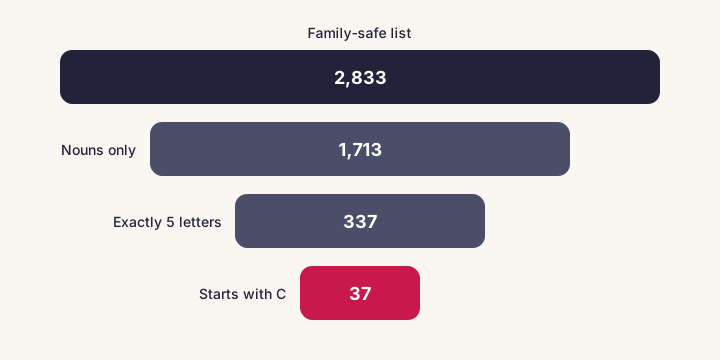
- Wordle practice: exactly 5 letters. The family-safe list holds 519 five-letter words, 337 of them nouns.
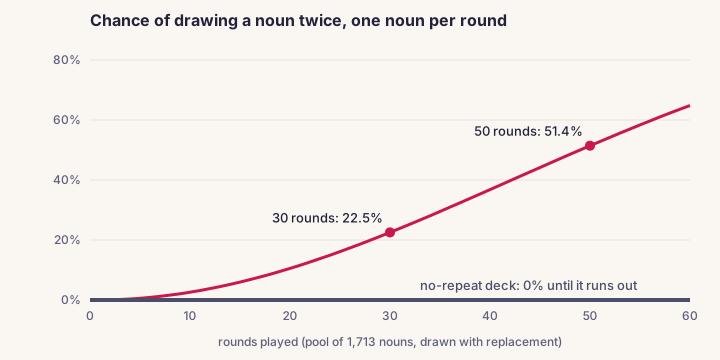
The deck is the feature I would not play without. Drawing one noun per round from the full pool, with the word going back each time, the chance that some word repeats in a game grows faster than people expect:
30 rounds: 1 − 0.7746 = 22.5%
50 rounds: 1 − 0.4857 = 51.4%
So in a long evening a repeat is more likely than not, and a repeated card is exactly when somebody shouts "we had that one". The deck deals without replacement and shows how many words are left ("12 of 1,713 left in the deck"). When it runs dry it says so and offers Reshuffle, and it rebuilds itself whenever you change a filter, so the repeat chance stays at zero until every card in the pool has been used.
A random noun to get a draft moving
When a story or a brainstorm is stuck, I use the random-entry move: take a word that has nothing to do with the problem and force a link.
- Write the focus in one line: "a better lunchbox".
- Draw one random noun. Say it comes up bridge.
- List what a bridge does or has: it spans a gap, it carries weight, it has railings, it can lift.
- Push each feature back onto the focus: a lunchbox with a divider that spans the box so wet food stays off the bread; a lid that carries a flat ice pack; a strap that clips like a railing to a bike rack.
Three ideas in a few minutes, none of which would have come from staring at the word lunchbox. Nouns work best for this; verbs are good for character prompts. Ten exercises, from three-word stories to letter-limited sprints, are in random word writing prompts.
Three activities I run with it in class
- Sort race. Project ten words on all classes. Pairs sort them into noun, verb, adjective and adverb columns, then check against the labels. Words with two labels start the best arguments.
- Letter chain. One word on the board; the next word must start with its last letter. "Starts with" deals the next word when the class runs dry.
- Length spelling bee. Exact length 4 for beginners, 7 or 8 for stronger groups. The exact-length setting keeps every round the same difficulty.
Setup times, group sizes and seven more games are in vocabulary games with random words.
Behind the draw: fairness, seeds and the test cases
Each draw takes the words that pass every filter (filters combine with AND, letters compare in lower case, length counts letters), shuffles a copy of that pool (sorted A to Z first) with a Fisher-Yates shuffle and takes the first ones. Because it takes from a shuffled copy, one result never holds the same word twice.
The random numbers come from the browser's crypto.getRandomValues(), which MDN describes as the cryptographically strong source, unlike Math.random() (MDN reference). A word game does not need that strength, but it costs nothing. To pick a number below n without bias, the tool throws away the few values at the very top of the 32-bit range:
n = 3: limit = 1,431,655,765 × 3 = 4,294,967,295, so only the single value 4,294,967,295 is redrawn
For a class or a writing group, an optional seed of up to 64 characters goes in the link after the # sign. Copy link puts the seed, your filters, the count and the mode into the address; with the seed box empty it makes a six-character seed for you. The seed text is hashed (FNV-1a, 32-bit, over its UTF-8 bytes) and drives a small seeded generator (mulberry32), so the same seed with the same filters gives the same words on every device. The part after # never reaches a server; nothing you type or draw is sent anywhere.
| Input | Expected result |
|---|---|
| Nouns, starts with Z, 10 words | zone, zoo, plus the notice "Only 2 words match these filters, so you get all of them." |
| Adverbs, starts with U | ultimately, under, unfortunately, up, usually (5) |
| Verbs, starts with K, family-safe on | keep, kick, kiss, knock, know (off: adds kill) |
| Adjectives, starts with X | 0 words: the counter says "No words match these filters" and no cards appear |
| Exactly 14 letters | 7 words, from characteristic to responsibility |
| Exactly 5 letters, family-safe on | 519 words match, 337 of them nouns |
| Deck of nouns starting with Z, drawn 3 times | zone and zoo once each, then the deck is empty |
| The word fit | noun · verb · adjective on its card |
| randInt(3) when the random source returns 4,294,967,295, then 7 | 1 (the first value is thrown away) |
| FNV-1a of "class7" | 1521257432 |
| mulberry32 started from 1, first three values | 0.6270739406, 0.0027357212, 0.5274470400 |
| Seed "class7", shuffle of a, b, c, d, e | c, a, e, b, d |
| Seed "class7", all words, family-safe on, 5 words | nearly, resident, moderate, direction, present |
| Seed "abc", verbs, 4 words | reverse, track, burn, seek |
| Situation | Chance |
|---|---|
| A given word appears in a draw of 5 from 2,833 | 5 / 2,833 = 0.18% |
| Two separate draws of 10 share at least one word | 3.5% |
| One noun per round from 1,713, 30 rounds, at least one repeat | 22.5% |
| Same, 50 rounds | 51.4% |
| No-repeat deck, any number of rounds until it is empty | 0% |
Questions and answers
Is a random word generator truly random?
No software is perfectly random, but this one uses the browser's cryptographic random source with rejection sampling and a Fisher-Yates shuffle, so every word that passes your filters has the same chance. With a seed in the link the list is deliberately repeatable instead.
What are good words for Pictionary and charades?
Concrete nouns you can draw, like ladder or bridge, and verbs you can act, like swim or climb; skip abstract words and draw again. Not affiliated with the makers of any game mentioned.
How do I know if a word is a noun or a verb?
Try "the" in front for a noun and "to" in front for a verb; many common words pass both, such as fish, judge and joke. Each card shows every class the word has.
How do I get random 5-letter words for Wordle practice?
Set the length to exactly 5 letters. With the family-safe filter on, 519 words match, 337 of them nouns.
Can I use random words for a password?
No. A list of 2,877 words gives roughly 11.5 bits per word, less than the 12.9 bits of a 7,776-word diceware list; use your password manager's generator.
Is anything I generate sent or stored?
Nothing is sent anywhere: words are drawn in your browser and the page makes no network calls. Only your saved list is kept, in your own browser's storage, until you clear it (Clear asks for a second press).
Guides
 Noun, verb, adjective or adverb? How to tell them apartFour sentence tests, the -ly trap, and why “light”, “fit” and “back” each do several jobs.6-minute read
 Random word writing prompts: 9 exercises that start a draftNine short exercises that turn one drawn word into a first draft, plus how to run them with a group.6-minute read
 Vocabulary games with random words for ESL and primary classesEight quick games, from Draw it to a spelling ladder, with the filters and timings that make each one work.6-minute read
Updated