Vocabulary games with random words for ESL and primary classes
Updated October 12, 2026 · 6-minute read · 4 sections
Vocabulary games with random words rescue the last ten minutes of a lesson: setup is one click, the words come from the screen instead of your head, and nobody can say you picked the hard ones for them. Here are eight games I run with ESL and primary classes, with timings, group sizes and the filters that make each one work.
I teach English and run a weekly games night, so I have watched the same words win and lose in both rooms. Short concrete words get a class laughing. Abstract ones kill the game in thirty seconds. Most of the work is choosing the right filter before you press Generate.
Level the list before you project it
The Oxford 3000 is a good yardstick for how big a core vocabulary should be: about 3,000 words chosen by frequency and usefulness in teaching, graded A1 900, A2 800, B1 700 and B2 600 (Oxford University Press explains the method). The generator uses the same kind of list, 2,877 common words (2,833 with the family-safe filter on), though it is not the Oxford list itself. Word length is a rough stand-in for difficulty, and I use it like this:
| Group | Class | Length |
|---|---|---|
| Young beginners, first reading | Nouns | up to 5 letters |
| Primary, some English | Nouns and verbs | up to 6 letters |
| Lower intermediate | All | 6 to 9 letters |
| Upper intermediate | Adjectives and adverbs | 8 letters and longer |
Length is only a guide: a five-letter word can still be tricky. Glance at the list before you project it.
Safety. Keep the family-safe filter on. It hides a few dozen words about violence, drugs, alcohol, insults and adult topics. No automatic filter is perfect, so read the list once before it reaches a screen.
The eight games at a glance
| Game | Group | Time | Filters |
|---|---|---|---|
| Draw it | teams of 4 to 6 | 10 to 15 min | Nouns or Verbs, deck on |
| Charades | teams | 10 min | Verbs, deck on |
| Word chain | pairs | 5 min | Nouns, Starts with |
| Hangman | whole class | 5 to 8 min | exact length |
| Sort race | teams | 10 min | All, labels hidden |
| Story circle | 6 to 24 students | 10 to 15 min | Nouns and Verbs |
| Spelling ladder | individuals or teams | 10 min | length 4, 5, 6 |
| Describe it | pairs or teams | 10 to 15 min | Nouns, 5 to 8 letters |
Eight vocabulary games with random words
1. Draw it
This is the classic drawing game. In the board game Pictionary the categories include Object (things you can touch or see) and Action (things that can be performed), the drawer looks at the card for up to five seconds, and the team has a minute; drawings may contain no letters or numbers, and the drawer may not speak or point (Wikipedia). That maps neatly onto concrete nouns and verbs. In the generator the Game card mode does the same: one big word, a 5-second peek (or a tap to hide it sooner), then a 60-second ring timer that ends with “Time’s up!”, then Next word.
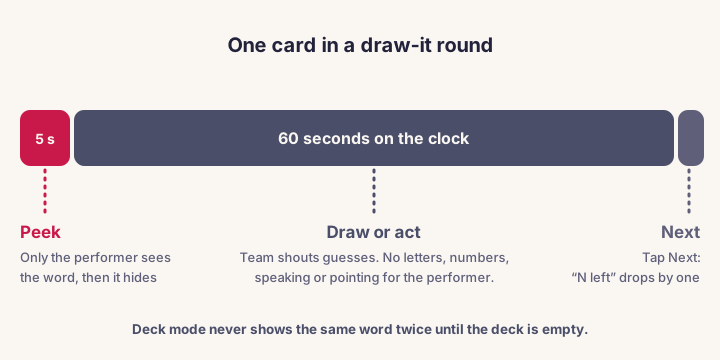
Turn on Deck mode so a word never comes up twice, and give each team a turn per card.
2. Charades
Draw verbs, not abstract nouns. “Climb”, “pour” and “whisper” can be acted. “Justice” cannot. Players act without speaking while their team calls out guesses. Add a rule that the same performer cannot go twice until everyone has gone.
3. Word chain
Set Nouns, then set Starts with to the last letter of the previous word and draw one. The next team has to use a word of their own that starts with that letter, in a sentence. Watch the endings: the list has no words that start with X, so a chain that lands on a word ending in X stops dead. The generator shows the word count beside every letter and switches off the letters with no matching words, which makes a handy lesson in how English spelling behaves.
4. Hangman with an exact length
Use the exact-length shortcut, draw one word, and write the blanks on the board. Five letters is a good default: the family-safe list has 519 five-letter words, 337 of them nouns. Students guess letters; each wrong guess adds a stroke.
5. Sort race
Draw 12 words from All words and copy them with Copy these words, which gives the words without labels. Teams sort them into four columns: noun, verb, adjective, adverb. Words that belong in two columns earn a bonus point. Press Save them all and download the list as CSV for an answer key, because it gives each word with its classes. If students argue, send them to the guide on telling the classes apart.
6. Story circle
Draw as many nouns as there are students. A single draw never repeats a word, so everyone gets a different one. Student one starts a story with a sentence that includes their word; each next student adds a sentence with theirs. Set the count to 24 and the room is ready in one click. To compare two groups, give both the same seed link and see how differently they tell the same words.
7. Spelling ladder
Start at 4-letter words. Each correct spelling moves a student up to 5, then 6 letters. A wrong spelling means the next word at the same length. Deck mode keeps the ladder fair, because each student sees fresh words.
8. Describe it
This is the Taboo-style game, best from B1 up. One player describes the word to their team without saying it or the three words you write on the board as forbidden. Draw nouns of five to eight letters, since shorter words have too few clues and longer ones too many.
Keeping it fair
- Use Deck mode. Drawing one noun per round with replacement gives a repeat sooner than people expect, as the table shows. A deck never repeats a word until it is empty, tells you how many are left and offers Reshuffle when it runs dry.
- Project the timer so nobody argues about seconds.
- Rotate roles. Everyone draws, acts and guesses at least once.
- Same words for every team when you need a fair comparison: share one seed link.
| Rounds | Without deck | With deck |
|---|---|---|
| 30 | 22.5% | 0% |
| 50 | 51.4% | 0% |
A repeat is a minor annoyance for a quiz and a serious one for a game where players have seen the answer. More on how the picker works is on the random word generator page. For adult groups and writers, see random word writing prompts.
Questions and answers
What level of words should I use for beginners?
Start with Nouns up to 5 letters. They are concrete, easy to draw and quick to spell. Move to verbs and longer words as the group grows more confident.
Is it safe to project the list in a primary classroom?
The family-safe filter is on by default and hides a few dozen words about violence, drugs, alcohol, insults and adult topics. No filter is perfect, so glance at the list before you project it.
How do I stop the same word coming up twice in a game?
Use Deck mode, which draws without replacement and shows how many cards are left. Changing filters rebuilds the deck.
Does the tool store anything about my students?
No. The tool sends nothing anywhere. A list you save stays in your own browser, and a seed in a share link sits after the # in the address, which the browser does not send to any server.
Are these official game words?
No. Pictionary, Taboo and other games are mentioned only to describe the game style. Not affiliated with the makers of any game mentioned.