Random word writing prompts: 9 exercises that start a draft
Updated October 12, 2026 · 6-minute read · 6 sections
Random word writing prompts work because they take the hardest decision, what to write about, off your plate. Draw one word you did not choose, and you have something to push against instead of a blank page.
I run a weekly writing group, and I have drawn words out of hats, envelopes and screens more times than I can count. The words that start good drafts are rarely the “inspiring” ones. They are concrete, slightly awkward, and impossible to ignore: a ladder, a ferry, a stubborn person. This guide shows how I use them, with nine exercises you can run in ten minutes each.
Why a word you did not pick helps
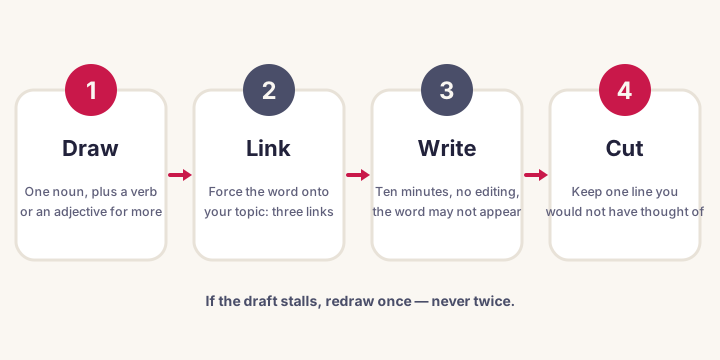
When you choose your own topic, you choose the obvious one. A random noun blocks that route. You cannot wait for a perfect idea, because the word is already on the table, so you have to build a connection yourself. That is the whole random-entry method in practical terms: take a word with no relation to your problem, force a link between them, and keep the link that surprises you.
I make no claim that it is magic. It works because producing a forced connection is an action you can start right now, while “be inspired” is not.
Pick the class before you draw
The random word generator lets you choose Nouns, Verbs, Adjectives or Adverbs. Each class gives you a different kind of material:
| Class | What it hands you | Best for |
|---|---|---|
| Noun | an object, place or person to build around | brainstorming, titles, scene settings |
| Verb | an action to show without naming it | scenes and “show, don’t tell” practice |
| Adjective | a mood or a trait to carry | characters, tone, description |
| Adverb | a manner or a voice | dialogue, stage directions |
Concrete nouns beat abstract ones every time. “Lantern” gives you a picture; “framework” gives you a meeting. If you draw something abstract, use it once as a mood, or redraw. Words with several classes, like “light” or “fit”, are bonus material: each extra job is a different story. If that idea is new, read how to tell nouns, verbs, adjectives and adverbs apart.
Nine random word writing prompts to try
1. Force a link (10 minutes)
Write your problem or topic at the top. Draw one noun. Write three ways the noun could solve, change or explain the problem, even badly. Circle the strangest.
Worked example. Focus: “a school newsletter students actually read.” Noun drawn: “lantern.” Links: a lantern lights the next few steps, so every issue opens with a one-line “what you missed”; one person carries it, so the editor’s job rotates each week; its light is small and focused, so each issue covers one story well. The second link is the one I would not have reached by thinking about newsletters.
2. Three-word story (10 minutes)
Draw one noun, one verb and one adjective. Write exactly 100 words that use all three. Read the words, start writing within a minute, and stop at 100.
3. Character from three words (15 minutes)
Draw an adjective, a noun and a verb. The adjective is the trait, the noun is where they spend their time, and the verb is the habit. A draw of “stubborn, ferry, borrow” already gives you a ferry worker who will not stop lending things. Write half a page about their worst morning.
4. Object as narrator (10 minutes)
Draw a concrete noun and write 150 words from its point of view. The object may not name itself. If you drew “umbrella”, it knows about rain and about being left on trains, but never says “I am an umbrella”.
5. Verb-first scene (10 minutes)
Draw a verb and a place noun. Write the scene so that the reader sees the verb happen but never reads the word. “Borrow” in a “kitchen” becomes a neighbour at the door and a cup that is never returned.
6. Adverb voice (5 minutes)
Draw an adverb and write a four-line exchange where one speaker talks that way, without ever using the adverb itself. “Politely” can be icy; “eagerly” can be exhausting. The exercise teaches you to place tone in the line instead of in a stage direction.
7. Letter sprint (5 minutes)
Set Starts with to one letter, draw six words, and write a 60-word paragraph that uses at least four of them. For a harder version, cut the paragraph to 40 words. Both versions are short enough to repeat with a new letter.
8. Title first (10 minutes)
Draw two nouns and join them: “The ___ and the ___”. Write the opening paragraph of the story that title promises. A title is a promise, and meeting it keeps you moving.
9. Five-minute freewrite (5 minutes)
Draw a single word, set a phone timer and keep the pen moving. Do not cross out and do not stop to think. When time is up, underline the best sentence and stop. Stalled sessions often start with this one because the stakes are tiny.
The rules I stick to
- One redraw, never two. The second redraw is procrastination in disguise.
- Do not pick. If you choose from a list, you are back to your own obvious taste.
- Write ugly first. The aim of the first ten minutes is a draft, not a good draft.
- Keep the word out of the final. Often the word is the scaffold, and the best version removes it.
- Time-box. Ten minutes with a timer beats an open evening.
From three words to a draft outline
Say the draw gives “lantern”, “borrow” and “stubborn”. A short story outline might run like this:
| Beat | What happens | Which word carries it |
|---|---|---|
| Opening | A neighbour asks to borrow a lantern for one night | borrow |
| Problem | The owner will not lend it; it was her father’s | stubborn |
| Turn | The power fails and she carries the lantern across the street herself | lantern |
| Ending | She keeps the lantern but starts lending small things | stubborn, changed |
Four beats, three words, and a draft of about 300 words that already has a shape. If one beat feels flat, redraw one word, not all three.
Run a writing group with a seed link
If everyone in the room should write from the same words, use the seed. The generator can put a seed and your filters into the link, and the same seed with the same filters gives the same list on every device.
- Set the class, the count and the filters you want. Leave Family-safe on if the group includes teenagers.
- Type a short seed, such as a name for the session.
- Press Copy link and paste it into the group chat or onto the board. If you leave the seed empty, Copy link makes a six-character one for you.
- Everyone opens it and sees the same words. Ask people not to change filters, because a different filter gives a different list.
The seed lives after the # in the address, which the browser never sends to a server, so nothing leaves the device. Use the link on the day rather than as an archive. For classroom use, the same trick appears in the vocabulary games guide.
Questions and answers
Do random words really help with writer’s block?
They give you something to start from. A drawn word removes the choice of topic, and forcing a link between it and your project is an action you can take immediately, even when you have no idea.
Which class of word is best for writing prompts?
Concrete nouns work best because they bring a picture. Use verbs for scenes, adjectives for characters and adverbs for dialogue practice.
How many words should one session use?
One to three. A single noun is enough for a ten-minute exercise; three mixed classes give you a ready-made story outline.
Can I use the same word twice?
You can, but the exercise gets easier. Drawing a new word, once, keeps the pressure on the part of the brain that has to improvise.