Noun, verb, adjective or adverb? How to tell them apart
Updated October 12, 2026 · 6-minute read · 7 sections
Is “light” a noun, a verb or an adjective? It is all three, and the only dependable way to stop guessing is to test the word inside a sentence. These are the four tests I hand to every new class, plus the traps that catch even strong learners.
A list of bare words invites the wrong question: “what part of speech is this word?” A word does not own a part of speech. It plays a job, and the sentence assigns the job. Once students accept that, labels stop feeling arbitrary, and a word like “fit” stops being a trick question.
Four tests that settle most words
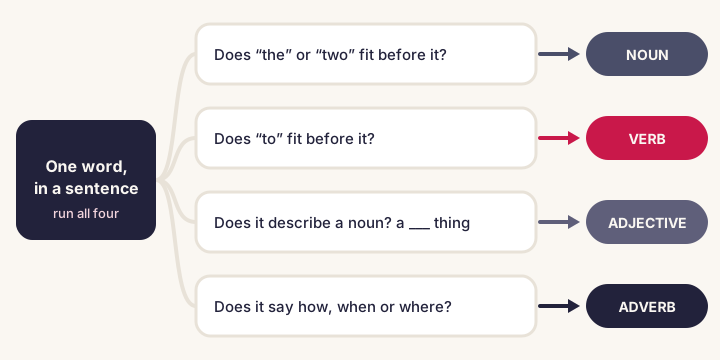
Put the word in a sentence first. Then run the tests below in order; a word can pass more than one, because the sentence only decides which job it is doing right now.
| Class | Test frame | Passes | Trap |
|---|---|---|---|
| Noun | “the ___” or “two ___s”; it names a thing, person, place or idea | the lantern, two lanterns | “the” also comes before adjectives (“the quick fox”), so check that the word is the thing itself |
| Verb | “to ___”, or it changes with “she ___s” and “yesterday I ___ed” | to borrow, she borrows | “to school” is a preposition plus a noun, not a verb |
| Adjective | “a ___ thing” and “very ___” | a quiet room, very quiet | “very” also fits adverbs (“very quietly”); ask what the word describes |
| Adverb | answers how, when, where or how much about an action | spoke quietly, left early | adverbs also modify adjectives (“very tall”) and other adverbs |
My rule for beginners: find the verb first. Everything else in a short sentence is easier once you know the action. If a student cannot find it, I ask “what is happening?” and they usually point at it.
Test the word in a sentence, never alone
Take “light”:
- The light is on. “The ___” fits, so it is a noun.
- Light the candle. “To light” fits, and it takes an object, so it is a verb.
- A light bag. It describes the bag, so it is an adjective.
Now “fast”. In a fast train it describes a noun, so it is an adjective. In he ran fast it says how he ran, so it is an adverb. The adverb is not “fastly”; that word does not exist, and it is the most common invented adverb I see in writing from learners.
The -ly clue that lies
Teachers love “adverbs end in -ly”, and it is right often enough to be dangerous. Two failures matter.
Adjectives that end in -ly. Friendly, lonely, lovely, silly, likely, lively and elderly are all adjectives: a friendly dog, not he behaved friendly. For the second idea you need a phrase, such as “in a friendly way”.
Adverbs with no -ly, and -ly forms with a different meaning. Pairs trip people up because the short form is not a sloppy version of the long one:
| Short form | Long form | Difference |
|---|---|---|
| She works hard. | She hardly works. | with great effort / almost not at all |
| He arrived late. | I saw him lately. | after the expected time / recently |
| Stand close. | Read it closely. | near / with careful attention |
Teach “fast”, “hard”, “well” and “early” as adverbs that happen to look like something else, and your class will stop adding -ly to everything.
One word, several jobs: what the generator shows
Roughly one word in five in the list works in more than one class. That is why the random word generator labels every card with all the classes a word has, always in the same order: noun, verb, adjective, adverb. I would rather see “fit: noun · verb · adjective” than a single label that quietly picks one.
| Word | Label shown | One sentence per job |
|---|---|---|
| fish | noun · verb | A fish is in the bowl. / We fish at dawn. |
| fit | noun · verb · adjective | A fit of giggles. / Fit the lid. / Fit for school. |
| light | noun · verb · adjective | The light is on. / Light the candle. / A light bag. |
| back | noun · verb · adjective · adverb | The back of the room. / Back the plan. / The back door. / Come back soon. |
| free | verb · adjective | Free the birds. / A free ticket. |
| kind | noun · adjective | What kind of cake? / A kind word. |
When a student draws “back”, I do not ask “what is it?” I ask “which job can you show me?” That one change turns a guessing game into a sentence-building task.
Words that look like adverbs but are not
Older word lists file “until”, “unless”, “upon” and “despite” under adverbs. None of them is an adverb, so I removed 23 such words from this list, and the Adverbs class now holds only real adverbs. They fall into four groups:
- Prepositions need a noun after them: until Friday, upon arrival, despite the rain, among friends, between us, within reach, without sugar.
- Conjunctions join clauses: although it rained, unless you ask, nor did she.
- Determiners and pronouns stand where a noun would: each, both, neither, none, such, whose.
- Interjections stand alone: yeah.
The practical test: an adverb can often move (“Usually, she walks”, “She usually walks”, “She walks, usually”) or stand alone. A preposition cannot be left without its noun.
The catch is that some words do both jobs, so I kept them. “Up” is an adverb in look up and a preposition in up the hill. “Before” is an adverb in I have seen it before, a preposition in before lunch and a conjunction in before you go. If the word has no noun after it and still makes sense, treat it as an adverb.
Quick quiz: name the job of the bold word
Cover the last two columns, answer, then check.
| # | Sentence | Class | Why |
|---|---|---|---|
| 1 | The fish are hungry. | noun | “the ___”, plural subject |
| 2 | They fish at dawn. | verb | the action; “to fish” |
| 3 | He ran fast. | adverb | says how he ran |
| 4 | A fast train. | adjective | describes the train |
| 5 | She spoke softly. | adverb | says how she spoke |
| 6 | A friendly dog. | adjective | -ly, but it describes the dog |
| 7 | Look up. | adverb | no noun follows |
| 8 | They back the plan. | verb | the action, with an object |
| 9 | I will be back soon. | adverb | says where, with “be” |
| 10 | Wait until Friday. | preposition | needs “Friday”; not a content class |
A five-minute class activity
- In the generator choose All words, set the count to 4 and leave Family-safe on. Draw. Hide the labels on the board or read only the words.
- Students write each word on a card and guess which classes it can have. Reveal the labels and score one point per class guessed right.
- Each team writes one sentence that uses all four words.
- For a bonus point, rewrite the sentence so that one word does a different job, for example “fish” as a verb instead of a noun.
Want the same four words on every screen? Add a seed and share the link, as described in the writing prompts guide. For longer games built on these labels, see vocabulary games with random words.
Questions and answers
Can a word be both a noun and a verb?
Yes, and many common words are, such as fish, judge and joke. The sentence decides: “a joke” is a noun, “to joke” is a verb. A good list shows every class a word has instead of one.
Are words ending in -ly always adverbs?
No. Friendly, lonely, lovely, silly and likely are adjectives. Check what the word describes: a noun means adjective, an action means adverb.
Why are until, despite and unless not in the Adverbs class?
They are prepositions or conjunctions, not adverbs. They need a noun or a clause after them, which an adverb does not. I removed them so the Adverbs class gives only words that really work as adverbs.
How do I find the part of speech of a word in a sentence?
Find the verb first, then ask what each remaining word does: names a thing (noun), describes a noun (adjective), or says how, when or where (adverb).